Mostrando postagens com marcador Noticia do Japao. Mostrar todas as postagens

Japão: Tepco anuncia prejuízo recorde e substituição do presidente

sexta-feira, 20 de maio de 2011

Sexta-feira, 20 de maio de 2011 - 06h49       Última atualização, 20/05/2011 - 08h34

Japão: Tepco anuncia prejuízo recorde e substituição do presidente

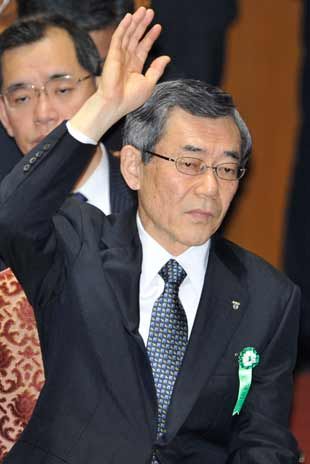
Foto: Yoshikazu Tsuno/AFP Zoom Masataka Shimizy deixou a presidência após prejuízos financeiros Masataka Shimizy deixou a presidência após prejuízos financeiros

Da AFP

mundo@eband.com.br

A empresa de energia elétrica Tepco (Tokyo Electric Power) anunciou nesta sexta-feira um prejuízo recorde de US$ 15,7 bilhões no último ano fiscal, concluído em março, e anunciou a substituição de seu presidente, em consequência do grave acidente na central nuclear de Fukushima.

O prejuízo de 1,25 trilhão de ienes (US$ 15,7 bilhões) é o maior registrado na história do país por uma empresa não financeira. O resultado da Tepco foi muito afetado pelo acidente na central nuclear de Fukushima Daiichi, o mais grave desde o de Chernobyl em 1986, após o terremoto e tsunami de 11 de março.

Antes do acidente, a Tepco esperava acabar o ano fiscal com um lucro de 110 bilhões de ienes (US$ 1,57 bilhão).

O grupo, que precisará da ajuda do Estado para indenizar as vítimas do desastre, não tem como fazer previsões financeiras para os próximos meses, já que a situação na central acidentada não poderá ser estabilizada antes de pelo menos seis meses.

A empresa também anunciou a saída do presidente Masataka Shimizy após a assembleia de acionistas de junho. Ele será substituído por Toshio Nishizawa.
     

ENVIE PARA UM AMIGO

FonteEband
READ MORE - Japão: Tepco anuncia prejuízo recorde e substituição do presidente

Moradores visitam por duas horas suas casas na região de Fukushima

terça-feira, 10 de maio de 2011

10/05/2011 05h43 - Atualizado em 10/05/2011 05h51

Moradores visitam por duas horas suas casas na região de Fukushima

Grupo usou roupas especiais e levou rádio para comunicação.
Outros moradores terão a mesma chance ao longo desta semana.

Do G1, com agências internacionais *
Com trajes de proteção brancos, máscaras e medidores de radiação, 92 pessoas retiradas de suas casas localizadas dentro do perímetro proibido da região da usina nuclear de Fukushima, no Japão, puderam retornar aos seus lares nesta terça-feira (10) para recolher pertences e objetos de valor.
Moradores do povoado de Kawauchi foram os primeiros desalojados a entrar no perímetro de exclusão de 20 km ao redor da central atômica. Retirados de outros oito municípios afetados pelas emissões radioativas do complexo nuclear poderão visitar seus lares durante esta semana.
Em 22 de abril, o governo declarou ilegal a entrada em um raio de 20 km da usina nuclear de Fukushima Daiichi, danificada pelos desastres naturais de 11 de março. O terremoto e o devastador tsunami daquele dia mataram 14.919 pessoas e deixaram 9.893 desaparecidos, segundo o último boletim da polícia local.
No território transformado em zona de exclusão viviam cerca de 80 mil pessoas.
92 moradores vestem roupas de proteção para uma breve visita às suas casas localizadas dentro da zona proibida da região da usina nuclear de Fukushima Dai-ichi. (Foto: Kyodo News / AP Photo)92 moradores vestem roupas de proteção para uma breve visita às suas casas localizadas dentro da zona proibida da região da usina nuclear de Fukushima Dai-ichi. (Foto: Kyodo News / AP Photo)
A urgência da situação de 11 de março fez com que os moradores deixassem para trás documentos, dinheiro e pertences importantes em suas casas. Por isso, eles pediram ao governo para que fossem autorizados a retornar a seus lares.
Durante duas horas os moradores de Kawauchi recolheram pertences que cabiam numa bolsa de 70 cm x 70 cm disponibilizada por especialistas. Eles também usaram luvas e levaram walkie-talkies.
Na volta, um ônibus os transportou para um ginásio onde todos foram submetidos a um exame para detectar nível de exposição à radiação. Antes de entrar, protestaram ao serem obrigados a assinar um documento no qual admitem ter entrado na área restrita por responsabilidade própria, informou a agência local “Kyodo”.
Outro município será esvaziado
O povoado de Iitate decidiu nesta terça que vai retirar os primeiros residentes após ordem do governo japonês de abandonar o município de maneira escalonada antes do final de maio, devido à radiação acumulada. Cerca de 400 residentes serão alocados em hotéis e outras instalações Fonte G1
READ MORE - Moradores visitam por duas horas suas casas na região de Fukushima

Barco que parou sobre prédio após tsunami é içado no Japão

Barco que parou sobre prédio após tsunami é içado no Japão

Guindaste retirou a embarcação em Otsuchi, prefeitura de Iwate.
Algumas pessoas queriam que ele ficasse lá, para lembrar a catástrofe.

Do G1, com AFP
Militares japoneses observam guindaste que retira o barco Hamayuri do topo de prédio de dois andares nesta terça-feira (10) em Otsuchi, na prefeitura de Iwate. A embarcação foi parar sobre o edifício por conta do terremoto de magnitude 9 seguido de tsunami de 11 de março. (Foto: AFP)Militares japoneses observam guindaste que retira o barco Hamayuri do topo de prédio de dois andares nesta terça-feira (10) em Otsuchi, na prefeitura de Iwate. A embarcação foi parar sobre o edifício por conta do terremoto de magnitude 9 seguido de tsunami de 11 de março. (Foto: AFP)
Alguns setores queriam preservar o barco no local como um monumento em memória da tragédia, mas o governo local decidiu pelo contrário. (Foto: AFP)Alguns setores queriam preservar o barco no local como um monumento em memória da tragédia, mas o governo local decidiu pelo contrário. (Foto: AFP)
  Fonte G1
READ MORE - Barco que parou sobre prédio após tsunami é içado no Japão

Governo do Japão manda fechar usina nuclear por risco de terremoto

sexta-feira, 6 de maio de 2011

06/05/2011 09h44 - Atualizado em 06/05/2011 09h44


Planta de Hamaoka fica sobre falha sísmica e oferece risco à segurança.
País enfrenta crise nuclear após terremoto e tsunami de 11 de março.

Da AFP
O primeiro-ministro do Japão, Naoto Kan, exigiu nesta sexta-feira (6) que o grupo Chubu Electric Power interrompa o funcionamento da usina nuclear de Hamaoka, situada na falha sísmica do centro do arquipélago.
"Ordenei que a Chubu Electric Power encerre as operações de todos os seus reatores na central nuclear de Hamaoka", declarou Kan.
"Tomamos esta decisão em função da segurança dos habitantes", acrescentou o primeiro-ministro japonês, que evocou um risco grande de terremotos nesta parte do país.
A decisão de Kan determina o fechamento de dois reatores, os de número 4 e 5, da usina na província de Shizuoka, a 200 km de Tóquio.
Imagem aérea de fevereiro de 2005 mostra a usina Chubu Electric Power, em Omaezaki, na prefeitura de Shizuoka (Foto: Reuters)Imagem aérea de fevereiro de 2005 mostra a usina Hamaoka, da Chubu Electric Power, em Omaezaki, na prefeitura de Shizuoka (Foto: Reuters)
O terremoto de magnitude 9 seguido de tsunami que atingiu o país em 11 de março provocou danos na unina de Fukushima Daiichi, jogando o país em uma crise nuclear ainda não totalmente resolvida.
VALE ESTE MAGNITUDE REVISADO - Entenda o terremoto no Japão (Foto: Arte/G1)
tópicos:
READ MORE - Governo do Japão manda fechar usina nuclear por risco de terremoto

segunda-feira, 25 de abril de 2011

25/04/2011 03h08 - Atualizado em 25/04/2011 03h14

Trem-bala japonês volta a funcionar entre Tóquio e Sendai após catástrofe

Veículo funcionou nesta segunda-feira (25) pela 1ª vez desde 11 de março.
Trem passou por casas temporárias construídas após tragédia.

Do G1, com informações de agências internacionais
Trem bala japonês volta a funcionar (Foto: Kyodo/Reuters)O trem-bala japonês, o shinkansen, voltou a funcionar na linha Tohoku Shinkansen, entre Tóquio e Sendai, nesta segunda-feira (25), pela primeira vez após o terremoto seguido de tsunami que atingiu a província de Miyagi no dia 11 de março. Na foto, o trem-bala passa nesta segunda-feira por casas temporárias construídas aos sobreviventes da catástrofe (Foto: Kyodo/Reuters)
Passageiros desembarcam de trem-bala, antes da sua partida para Tóquio, na estação de Sendai, em Miyagi. (Foto: Kazuhiro Nogi/AFP)Passageiros desembarcam de trem-bala, antes da sua partida para Tóquio, na estação de Sendai, em Miyagi. (Foto: Kazuhiro Nogi/AFP) Fonte eband
READ MORE -

Stricter enforcement of nuclear evacuation zone to begin

quinta-feira, 21 de abril de 2011

Stricter enforcement of nuclear evacuation zone to begin

By the CNN Wire Staff
April 21, 2011 -- Updated 0726 GMT (1526 HKT)
Police guard a checkpoint in Minamisoma, Japan, just outside  the 20km exclusion zone.
Police guard a checkpoint in Minamisoma, Japan, just outside the 20km exclusion zone.
STORY HIGHLIGHTS
  • Evacuation order covers zone within 20-kilometers of the nuclear plant
  • Enforcement has been uneven from checkpoint to checkpoint
  • "I wish I could trust the government, but I can't," an evacuee tells CNN
  • A government official says the crackdown is needed for public safety
Tokyo (CNN) -- Japan will on Friday begin enforcing an evacuation order on a 20-kilometer zone around the Fukushima Daiichi nuclear power plant, a top government official said.
The restriction --in place since the early days of the nuclear disaster -- has often been ignored.
Many of the about 78,000 people who have homes in the evacuation zone have gone back in recent weeks to retrieve belongings, and check on farms and businesses.
No one will be allowed within 3 kilometers of the crippled nuclear facility and entry within 20 kilometers of the plant will be highly regulated, Chief Cabinet Secretary Yukio Edano told reporters Thursday.
People who temporarily return to their homes, businesses and farms must wear a protective suit and ride into the restricted zone on a designated bus.
Gallery: Inside Japan's nuclear zone
Fukushima Exclusion Zone tour
Sharing experiences of disaster
The time limit for such visits will be two hours and everyone who enters will be required to go through a decontamination process.
The stricter enforcement within the zone is necessary "to guarantee the health and safety of the people," Edano said previously, noting that Tokyo will work with local officials in closing the zone.
Edano said the government plans to designate the area an "alert zone" under Japanese laws governing disaster response, a move he said would give authorities the power to crack down on people going into and out of the evacuated area.
Police are currently stationed at checkpoints leading into the area, but enforcement appears to vary from post to post or officer to officer.
A CNN crew entered the area for a short time Wednesday and encountered a young farmer whose family lives just inside the 20-km (12.5-mile) boundary. He said his father was considering returning home -- but as a young, unmarried man, he was considering quitting the farm his family has worked for three generations.
"I'm concerned about the impact on my health," said the farmer, who declined to be named. "I wish I could trust the government, but I can't."
The disaster, now the worst nuclear accident since Chernobyl, occurred when the Fukushima Daiichi plant was struck by the March 11 tsunami that devastated northern Japan, knocking out its coolant systems and causing its three operating reactors to overheat.
The plant's operator, Tokyo Electric Power Co., said Thursday that a meltdown could be taking place at the troubled facility, but also acknowledged that there's no way to know for sure.
TEPCO told CNN that it cannot say that the nuclear fuel rods at the three reactors have never melted or that they are not melting right now, nor can the company say for certain that the rods have melted or are melting now.
The Japanese government says it has no detailed readings of radiation levels inside the 20-km zone. But journalists who have entered the areas have recorded radiation levels that typically range around a few thousandths of a millisieverts per hour. By comparison, a typical resident of an industrialized country receives about 3 millisieverts per year.
One reporter who came within 2 kilometers of the power plant in early April recorded a dose of about a tenth of a millisievert per hour -- high enough to increase the long-term risk of cancer with prolonged exposure, but a tiny fraction of the dose that would induce radiation sickness.Fonte CNN
READ MORE - Stricter enforcement of nuclear evacuation zone to begin

Flying drone peers into Japan's damaged reactors

quarta-feira, 20 de abril de 2011

Flying drone peers into Japan's damaged reactors

By Matt Smith, CNN
April 10, 2011 -- Updated 1837 GMT (0237 HKT)
A remote-controlled helicopter with a camera attached was sent over the damaged nuclear power plant Sunday to get pictures.
STORY HIGHLIGHTS
  • NEW: Large pumps set to arrive in Japan this week
  • A plant worker falls ill and is diagnosed with exhaustion
  • Engineers hope the drone will give them a better picture of the reactors
  • More than 2,000 people protest against nuclear power in Tokyo
Tokyo (CNN) -- Engineers used a flying drone to peer into the damaged reactors at the Fukushima Daiichi nuclear power plant Sunday as the crisis spurred more than 2,000 people to march against nuclear energy in Tokyo.
"I was just a couch potato critic, but here we are today with friends for the first time, and I'm sure it's the first time for a lot of people today," said Karima Asuma Stickan, one of the protesters.
Monday marks a full month in the battle to prevent a worse disaster at Fukushima Daiichi, which was battered by the earthquake and resulting tsunami that struck northern Japan on March 11. Japan's largest utility, Tokyo Electric Power Company, has been struggling to cool down three damaged reactors and prevent a wider release of radioactivity than has already occurred.
Improvisation, frustration in week four of crisis

A camera was mounted on a remote-controlled helicopter to get pictures of the damaged reactors from above Sunday in hopes of getting a better look at the damaged housings of the No. 1, 3 and 4 reactors and hopefully the pools of spent fuel inside, company spokesman Junichi Matsumoto said. The drone hovered over the plant for 28 minutes at an altitude of about 150 meters (492 feet), he said.
The T-Hawk drone, built by the U.S. company Honeywell, can transmit ordinary pictures as well as infrared images, Matsumoto told reporters. Images captured by the drone are expected to be released Monday, he said.
In addition, the company is now using remote-controlled heavy machinery to clear away debris outside the plant and has begun the process of laying new pipes to start pumping radioactive water out of the flooded basements of the turbine plants behind units 1 through 3.
Driving into Japan's radiation zone Video
One worker fell ill during the work on Sunday, the company said. The man, in his 30s, was placing hoses for collecting the contaminated water from reactor No. 2 when he became ill, nearly two hours into his shift.
48-foot wave hits nuclear plant
Journalist enters radiation zone
Radiation fears slow Japan's economy
Japan catastrophe: CNN photo story
The subcontractor was taken to a hospital, where he was diagnosed with exhaustion, Tokyo Electric said. He was exposed to 4.82 millisieverts of radiation, but no radioactive substances were found on his body. His cumulative exposure is 16 millisieverts, well below the 250-millisievert limit for workers in the plant. He was with a group of 30 subcontractors working in the area, and was wearing protective gear, the company said.
Japan launches new search for quake victims
The man had been working four-hour shifts since March 23, Tokyo Electric said. It was unclear whether he had received a day off.
Meanwhile, two of the world's largest concrete pumps were en route to Japan on Sunday as part of the effort to help resolve the crisis.
The pumps left the United States on Saturday -- one from Los Angeles and the other from Atlanta, said Bill Dwyer, vice president of sales and marketing for Putzmeister America, the pumps' manufacturer.
Although the pumps were built to pump concrete, they can be modified to pump water at high pressure, with a 230-feet reach and "pinpoint accuracy," Dwyer said Sunday. "It allows workers to work from a greater distance," he said.
One pump is set to arrive in Japan on Monday and the second on Tuesday, he said.
Workers have been pouring hundreds of tons of fresh water a day into the three damaged reactors and the spent fuel pools of units 1-4 to keep them cool until normal circulation systems can be restored. The No. 2 reactor is believed to be leaking highly radioactive water, some of which had been spilling into the Pacific until Wednesday, while flooded basements in the turbine plants of all three units are making it impossible to restore power, company officials say.
To make room for the fluid, Tokyo Electric has been dumping less contaminated water into the Pacific Ocean from a waste treatment facility on the site. That process -- which also includes the release of radioactive water from the drainage basins beneath reactors 5 and 6 -- was nearly complete Sunday evening, Japan's Nuclear and Industrial Safety Agency reported.
The radioactive particles in the water are dispersing into the ocean. But concentrations of radioactive iodine-131 remained 25 times higher than the Japanese legal standard in water sampled 16 kilometers (10 miles) south of the plant on Saturday.
That's down from 93 times the limit on Wednesday, according to sampling data released Sunday. Levels of longer-lived cesium-137, which takes 30 years to lose half its radioactivity, remained nearly six times the legal limit but well below levels reported earlier this week.
The discharge was billed as an emergency measure, but it infuriated Japan's fishing industry and drew protests from neighboring South Korea. And participants in Sunday's protest in Shiba Park, at the foot of the landmark Tokyo Tower, expressed concern about the long-term effects of the radioactive releases so far.
Japanese turn in cash found in tsunami zone

"The air pollution gets into the lungs," said Dr. Nobuhiko Murapsu, a pulmonary care physician from Chiba Prefecture, north of Tokyo. "Five years, 10, 20 years later, they get lung cancer. This is a very severe problem."
Murapsu said he's changed his views on nuclear power since the accident and decided to join the demonstration. Protesters marched from the park, ringed with cherry blossoms, to Tokyo Electric's headquarters and on to the Ministry of the Economy, Trade and Industry, which regulates Japanese nuclear power plants.
Makiko Mikami told CNN that no one believes they're getting enough answers from either the utility or the government.
"The problem is, I think I'm not sure they know the whole picture themselves," Mikami said. "If they know, they should share that information with us. And if they don't, they should admit that they're scared as well." Fonte CNN
READ MORE - Flying drone peers into Japan's damaged reactors

Após fechamento provocado pelo terremoto, Disney de Tóquio reabre

quinta-feira, 14 de abril de 2011


japão
14/04/2011 21h26 - Atualizado em 14/04/2011 21h26

Após fechamento provocado pelo terremoto, Disney de Tóquio reabre

Parque ficou fechado um mês depois de tremor e tsunami de 11 de março.
Fornecimento instável de energia elétrica foi um dos motivos do fechamento.

Do G1, com Reuters
Japonesa abraça o camundongo Mickey nesta sexta-feira (15) na Disneylândia de Tóquio, em Urayasu, a leste da capital do Japão. (Foto: Reuters)Japonesa abraça o camundongo Mickey nesta sexta-feira (15) na Disneylândia de Tóquio, em Urayasu, a leste da capital do Japão. (Foto: Reuters)
 O parque temático reabriu depois de ter ficado quase um mês fechado após o terremoto seguido de tsunami de 11 de março. O fechamento foi provocado pela instabilidade do fornecimento de energia elétrica na região. (Foto: Reuters) O parque temático reabriu depois de ter ficado quase um mês fechado após o terremoto seguido de tsunami de 11 de março. O fechamento foi provocado pela instabilidade do fornecimento de energia elétrica na região. (Foto: Reuters)
tópicos:     Fonte G1
READ MORE - Após fechamento provocado pelo terremoto, Disney de Tóquio reabre


Postagens populares